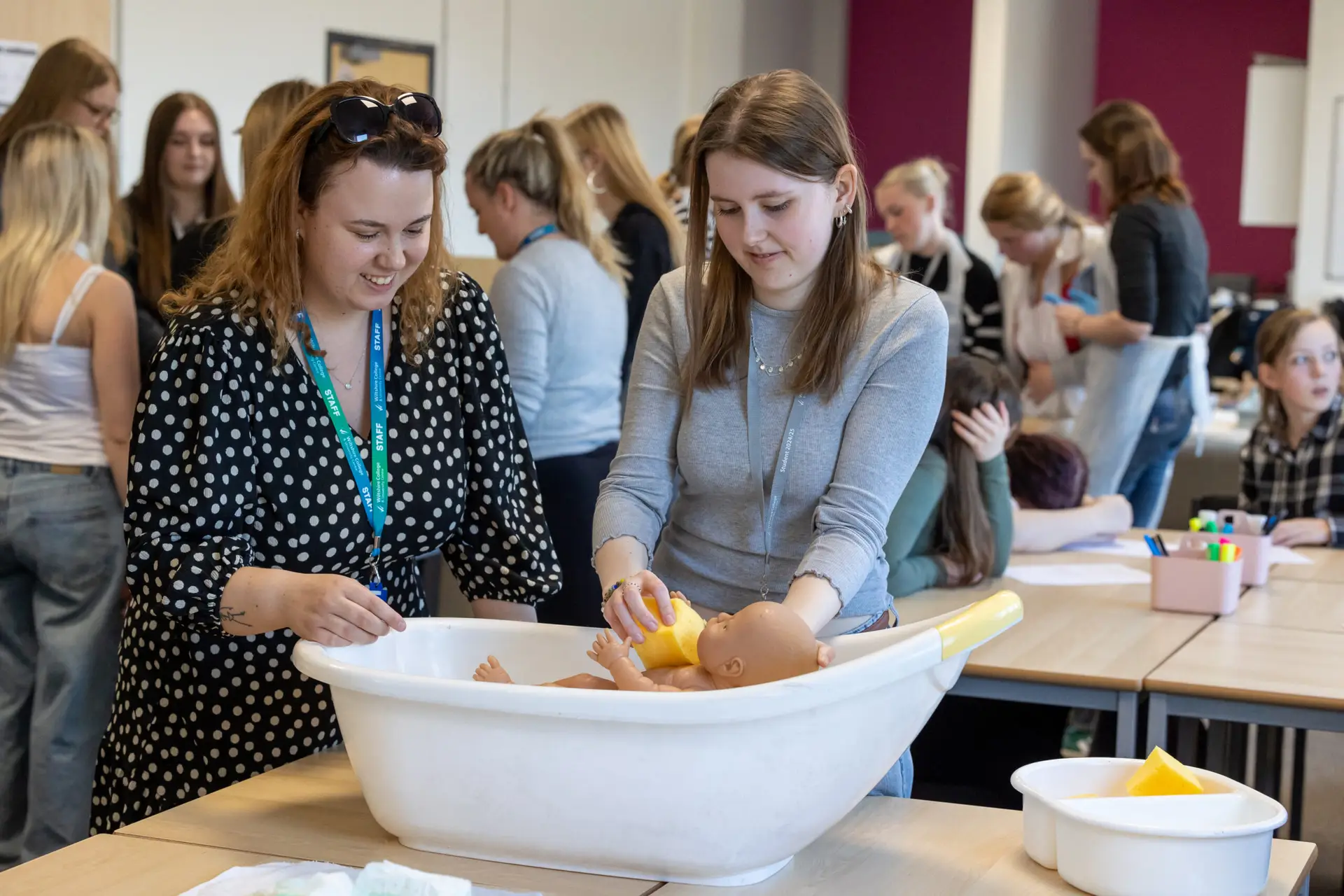
This qualification is ideal for learners looking to work with children between birth and 5 years, and gain knowledge of working with children up to 7 years. Early Years Practitioners are responsible for supporting child initiated and adult led activities based around the needs and interests of each individual child, supporting children’s learning through planned, purposeful play opportunities and educational programmes and working as part of a team to ensure each child feels safe and secure. An EYP will also support the observation and assessment of each child and contribute to their learning experiences, they assist with the care needs such as feeding, changing nappies and toileting under direction of a more senior member of the team. They work in partnerships with other colleagues, parents, carers and other professionals, to meet the individual needs of each child.
Home > Early Years Practitioner (Level 2)
Early Years
Early Years Practitioner (Level 2)
Apprenticeship
Early Years
Flexible
Study Mode
Apprenticeship
Start Date, Location
Aug 2025, Flexible
Duration
14 months
Cost
£.00
per academic year.
Course Overview
More information
What will I learn?
This apprenticeship is made up of the Level 2 Early Years Practitioner Apprenticeship Standard.
In apprenticeships, Knowledge, Skills and Behaviours (KSBs) are essential components that define the competencies an apprentice must demonstrate.
The Level 2 Early Years Practitioner Apprenticeship is made up of these Knowledge, Skills and Behaviours. They are assessed at the end of the Apprenticeship in an End Point Assessment and cover topics such as:
– Working in partnership with other colleagues, parents, carers or other professionals to meet the individual needs of each child in line with company policies and procedures
– Using play to support children’s individual learning and development needs
– Identifying issues of safeguarding and child protection, ensuring that the welfare and safety of children is promoted and safeguarded, reporting any child protection concerns to the person in charge
– Carrying out regular self-reflection and using continuous professional development opportunities to improve practice
– Undertaking specific tasks related to the safety and hygiene of the children and the cleanliness of the setting
– Demonstrate appropriate verbal and written communication taking into account individual needs, including English as a second language, additional needs and disabilities
– Using their knowledge of child development to work with parents and carers to improve children’s outcomes and wellbeing, including those with disabilities and additional needs
– Contributing to the planning and organisation of activities to support and extend children’s learning in line with the Early Years Foundation Stage
– Supporting the collection of accurate and up-to-date records which identify children’s individual needs, abilities and progress and use these as a basis for future planning
There is no college attendance for this apprenticeship. Learning will take place both within the workplace and in your non-working time. You must be able to study independently outside of the workplace. Your practical skills will regularly be observed by your assessor.
In apprenticeships, Knowledge, Skills and Behaviours (KSBs) are essential components that define the competencies an apprentice must demonstrate.
The Level 2 Early Years Practitioner Apprenticeship is made up of these Knowledge, Skills and Behaviours. They are assessed at the end of the Apprenticeship in an End Point Assessment and cover topics such as:
– Working in partnership with other colleagues, parents, carers or other professionals to meet the individual needs of each child in line with company policies and procedures
– Using play to support children’s individual learning and development needs
– Identifying issues of safeguarding and child protection, ensuring that the welfare and safety of children is promoted and safeguarded, reporting any child protection concerns to the person in charge
– Carrying out regular self-reflection and using continuous professional development opportunities to improve practice
– Undertaking specific tasks related to the safety and hygiene of the children and the cleanliness of the setting
– Demonstrate appropriate verbal and written communication taking into account individual needs, including English as a second language, additional needs and disabilities
– Using their knowledge of child development to work with parents and carers to improve children’s outcomes and wellbeing, including those with disabilities and additional needs
– Contributing to the planning and organisation of activities to support and extend children’s learning in line with the Early Years Foundation Stage
– Supporting the collection of accurate and up-to-date records which identify children’s individual needs, abilities and progress and use these as a basis for future planning
There is no college attendance for this apprenticeship. Learning will take place both within the workplace and in your non-working time. You must be able to study independently outside of the workplace. Your practical skills will regularly be observed by your assessor.
Entry Requirements
Before enrolment all applicants will have an informal interview where we will outline the commitment, engagement and self-study requirements of the apprenticeship, and the resources and support available from the college. Applicants will have the opportunity to discuss their learning needs and to ask any questions.
Apprentices who do not hold maths & English Functional Skills Level 1, GSCE grades 3 (D), or equivalent, will need to study these alongside the apprenticeship and pass them, as well as attempting Functional Skills Level 2, prior to being progressed for their End Point Assessment.
Apprentices who already have a Level 1 in maths and English prior to enrolment, must work towards Level 2 throughout their apprenticeship and sit the assessments for them.
You must be working in an early years setting for a minimum of 3 days a week (from 9am to 3pm).
There is no mandatory requirement for apprentices to work with babies and children in the Birth to 2 years age range, however this age range is covered in the End Point Assessment, and you must be able to speak about a range of topics relating to babies to achieve the apprenticeship.
We recommend speaking to your employer to arrange a placement to gain experience if you do not have babies and children aged Birth to 2 years in your setting.
If an employer has agreed to support you on this apprenticeship, contact the Apprenticeship team and we’ll get you started. Email apprenticeships@wiltshire.ac.uk or call 0845 345 2235.

Apprentices who do not hold maths & English Functional Skills Level 1, GSCE grades 3 (D), or equivalent, will need to study these alongside the apprenticeship and pass them, as well as attempting Functional Skills Level 2, prior to being progressed for their End Point Assessment.
Apprentices who already have a Level 1 in maths and English prior to enrolment, must work towards Level 2 throughout their apprenticeship and sit the assessments for them.
You must be working in an early years setting for a minimum of 3 days a week (from 9am to 3pm).
There is no mandatory requirement for apprentices to work with babies and children in the Birth to 2 years age range, however this age range is covered in the End Point Assessment, and you must be able to speak about a range of topics relating to babies to achieve the apprenticeship.
We recommend speaking to your employer to arrange a placement to gain experience if you do not have babies and children aged Birth to 2 years in your setting.
If an employer has agreed to support you on this apprenticeship, contact the Apprenticeship team and we’ll get you started. Email apprenticeships@wiltshire.ac.uk or call 0845 345 2235.
Study, Assessment and Qualifications
The Level 2 Early Years Practitioner Apprenticeship is not a taught course; you must be able to study in your own time. You will be assigned an assessor who will provide you with resources and support to complete each unit through a range of assessments.
Apprentices will be assessed and prepared for the Apprenticeship End Point Assessment by their assessor through a range of methods, including written assignments, direct observation in the workplace, professional discussions, creative tasks and the preparation of a portfolio of evidence which will be used in the End Point Assessment.
The End Point Assessment is the final assessment an apprentice undertakes to complete their apprenticeship and is carried out by an independent assessor.
It consists of an observation of practice with questioning and a professional discussion underpinned by the portfolio of evidence.
On successful completion of the End Point Assessment the apprentice will be awarded the Level 2 Early Years Practitioner Apprenticeship with a Pass or Distinction.
Apprentices must record a minimum of 300 hours of learning and development, this is called ‘Off the Job Training’, which must take place during your paid working hours. This can include work shadowing, training, workshops, online learning, mentoring, time for assignment writing or revision. In fact, any learning and development that supports learning on the apprenticeship can be recorded.
Apprentices will be assessed and prepared for the Apprenticeship End Point Assessment by their assessor through a range of methods, including written assignments, direct observation in the workplace, professional discussions, creative tasks and the preparation of a portfolio of evidence which will be used in the End Point Assessment.
The End Point Assessment is the final assessment an apprentice undertakes to complete their apprenticeship and is carried out by an independent assessor.
It consists of an observation of practice with questioning and a professional discussion underpinned by the portfolio of evidence.
On successful completion of the End Point Assessment the apprentice will be awarded the Level 2 Early Years Practitioner Apprenticeship with a Pass or Distinction.
Apprentices must record a minimum of 300 hours of learning and development, this is called ‘Off the Job Training’, which must take place during your paid working hours. This can include work shadowing, training, workshops, online learning, mentoring, time for assignment writing or revision. In fact, any learning and development that supports learning on the apprenticeship can be recorded.
Additional Costs and Information
Learners will use an e-portfolio for the duration of their course. Access to a lap-top, computer or other device with Internet, camera and audio is required. Learners will not be able to complete this course on a phone or small tablet due to the different types of assessments that must be completed.
If you do not have a suitable Internet connected device your employer may be able to apply for a loan of one from Wiltshire Digital Drive www.wiltshiredigitaldrive.org
There is no required textbook for this course, your assessor will provide you with many resources, but you will also need to carry out your own research for written assignments. Our Learning Resource Centres have a range of books and resources to support this course. The cost of any other books or resources for this course will be met by the student.
If you do not have a suitable Internet connected device your employer may be able to apply for a loan of one from Wiltshire Digital Drive www.wiltshiredigitaldrive.org
There is no required textbook for this course, your assessor will provide you with many resources, but you will also need to carry out your own research for written assignments. Our Learning Resource Centres have a range of books and resources to support this course. The cost of any other books or resources for this course will be met by the student.
Ready to apply?
Careers
Other upcoming events
Trowbridge Student Art Exhibition
11 June 2026
18:00
30 November -0001
0:00
30 November -0001
0:00
30 November -0001
0:00
Chippenham Student Art Exhibition
18 June 2026
18:00
30 November -0001
0:00
30 November -0001
0:00
30 November -0001
0:00
Salisbury Student Art Exhibition
18 June 2026
18:00
30 November -0001
0:00
30 November -0001
0:00
30 November -0001
0:00
Castle Combe Open Event: September 2026
26 September 2026
12:00
30 November -0001
0:00
30 November -0001
0:00
30 November -0001
0:00
Trowbridge open event: September 2026
30 September 2026
17:00
30 November -0001
0:00
30 November -0001
0:00
30 November -0001
0:00
Lackham open event: October 2026
03 October 2026
17:00
30 November -0001
0:00
30 November -0001
0:00
30 November -0001
0:00
Chippenham open event: October 2026
06 October 2026
17:00
30 November -0001
0:00
30 November -0001
0:00
30 November -0001
0:00
Salisbury open event: October 2026
08 October 2026
17:00
30 November -0001
0:00
30 November -0001
0:00
30 November -0001
0:00